

Please scan the QR code to register your interest by 17 July 2026. Confirmation will be sent by email.
Dress code: Formal
Presentation Materials
Download the Full Programme
Download the full presentation from the 2nd Annual Public Lecture Series held on 5 August 2026. Featuring five Global Fellows (2026–2027). the series challenged conventional approaches to digital education and explored new ideas, insights and possibilities.
About the Series
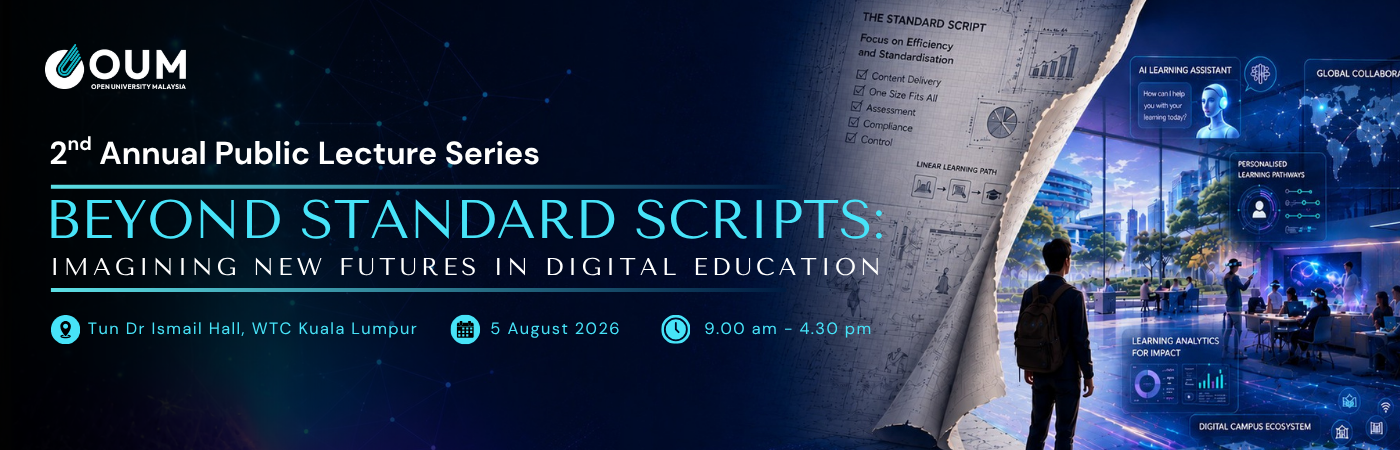
OUM’s 2nd Annual Public Lecture Series features the University’s Global Fellows (2026–2027 cycle), five of the world’s most distinguished scholars on digital education, whose work collectively challenges the assumptions that currently dominate the field. Their lectures converge around the theme of this year’s series: Beyond Standard Scripts: Imagining New Futures in Digital Education.
The series comprises five public lectures, each addressing this theme from a distinct vantage point.
Much of the current discourse on digital education remains shaped by narratives of efficiency, automation, and systems optimisation — framings driven largely by commercial imperatives and short-term solutions, with insufficient attention to their social, cultural, and ecological consequences. The rapid expansion of artificial intelligence has intensified these pressures, raising urgent questions about whose values are encoded in the systems being built, and who bears the cost when those systems fall short. When digital futures are imagined in these terms, education risks being reduced to what can be measured, predicted, or controlled, rather than approached as something that grows and deepens human potential and social possibility.
It is against this backdrop that the series turns toward forms of thinking that open space for alternative educational possibilities that existing frameworks struggle to accommodate.
At the heart of this inquiry are three questions:
What assumptions about speed, scale, and efficiency are currently shaping digital education — and what might be possible if those assumptions were questioned?
Whose values, interests, and knowledge are built into the digital futures being designed for education — and how might those futures be made more just, inclusive, and human-centred?
How might educators, institutions, and communities become active authors of digital education futures, rather than passive recipients of systems designed elsewhere?
Designed to engage policymakers, educators, learners, parents, and the wider community, the series reflects OUM’s ongoing commitment to inclusive and participatory dialogue.
As an institution grounded in public engagement, OUM seeks to create sustained spaces where diverse voices can question, reflect, and contribute to shaping more just and human-centred educational futures.
Speakers & Lecture Titles
Public Lecture 1
Designing for Scale and Localising for Inclusion: Towards or Away From Technology-Enabled Teacher Professional Development at Scale?
Prof Lim Cher Ping
Global Institute for Emerging Technologies, The Education University of Hong Kong (Hong Kong SAR, China)
Teacher professional development has always been faced with the challenges of equity, quality, and efficiency. These challenges are particularly significant for teachers serving marginalised communities or who come from these communities. Emerging technologies provide opportunities to scale quality professional development through access to professional learning resources and support. However, designing for scale may produce a one-size-fits-all solution that does not meet the diverse learning needs of teachers, and may not be meaningful or relevant to all.
This lecture examines how localisation is critical for inclusion to ensure equitable quality professional development at scale. It then challenges the traditional definition of professional development as planned, structured, and institutionalised. As the use of emerging technologies becomes increasingly student-driven, teachers are expected to take up greater agency, empowered to monitor and manage their own professional learning.
These shifts raise two questions: Have planned teacher professional development programmes increasingly become disempowering? And how can teachers be empowered to engage in their own professional learning?
Public Lecture 2
AI for All? Missing Pieces and the Role of Higher Education
Prof Emeritus Shinobu Yume Yamaguchi
Institute for the Advanced Study of Sustainability (UNU-IAS), United Nations University (Japan)
With the exponential and relentless development of AI, humanity stands at an unprecedented crossroads. We face a civilisational challenge in steering this volatile trajectory towards a sustainable and human-centred future. This lecture issues an urgent call for higher education to rethink its role in this transition.
Drawing on key policy documents and guidelines from the United Nations, the lecture explores “missing pieces” in current AI narratives within the higher education sector, specifically those related to equity and inclusion. By deliberating on measures to prevent intersectional AI divides, the lecture identifies how AI risks further marginalising — or conversely, creating enormous benefits for — persons with disabilities, Indigenous knowledge systems, and gender equality.
The lecture provides concrete policy recommendations for university administration and educators, advocating for human-centred approaches to AI governance whereby people and communities shape AI to advance human capacity and rights, collective well-being, and social justice.
Public Lecture 3
Σιγά Σιγά: Toward a Better Tempo for Digital Education
Prof George Veletsianos
College of Education and Human Development, University of Minnesota-Twin Cities (USA)
Discussions of digital education are saturated with the grammar of speed and acceleration, and finding the vocabulary to push back is harder than it should be. This lecture offers one such phrase: Σιγά Σιγά (siga siga), a Greek phrase meaning “slowly slowly.” Siga siga is more than a translation of “slow.” It names an enduring disposition and a way of inhabiting time that platformed education tends to foreclose. It offers a substantive counter-value to the efficiency scripts shaping digital education today.
At the pedagogical level, siga siga invites us to ask what forms of knowing, relating, and becoming only become possible when learning is given the time it actually takes. Real-time analytics, instant grading, continuous engagement metrics, and algorithmic pacing all encode the same assumption: that compressing time improves learning. It is worth reflecting on what this assumption costs.
At the institutional level, siga siga offers universities a posture toward technological adoption that resists the prevailing fear of missing out and of being left behind. The recent histories of MOOCs and now Generative AI follow a familiar pattern: a technology arrives, vendors and consultancies declare its inevitability, and institutions race to adopt it before they have understood its implications.
Siga siga is a refusal of induced urgency, and an invitation to take the time to understand what a technology does to relationships, to judgement, and to the conditions of learning, before deciding what role, if any, it should play.
Public Lecture 4
Futures of Care in Digital Education
Prof Felicitas Macgilchrist
School of Educational and Social Sciences, Carl von Ossietzky University of Oldenburg (Germany)
If imaginative inquiry is willing to transgress prevailing frameworks and reshape the discourse underlying education, it is likely rooted in rage, anger, or dismay at the state of the world today. As the philosophy of hope notes, however, it is from rage that hope emerges. Hope, in this lecture, is not optimism. Hope is born from the destruction, exploitation, and cultural devastation created in the ruins of our damaged planet.
This lecture traces a path from a hopeful politics of care — as seen in the ongoing invisible work of sustaining community in digital education — to speculative practices that allow new worlds to be imagined and built. Against the logics of efficiency, acceleration, and individualisation, the lecture asks what becomes possible when we design digital education from the entangled practices of rage, hope, and care.
Public Lecture 5
Beyond Intelligent Automation: Reimagining Human-Centred Futures for Digital Education
Prof Bart Rienties
Institute of Educational Technology, The Open University (UK)
The rapid expansion of artificial intelligence, learning analytics, and digital platforms is fundamentally reshaping education across schools, universities, and lifelong learning systems. Yet much of the current discourse surrounding digital transformation remains dominated by narratives of efficiency, automation, optimisation, and scale. This lecture contends that education risks losing sight of its fundamentally human purpose if digital futures are designed primarily around what can be measured, predicted, or automated.
Drawing on recent research on AI digital assistants, learning analytics, and large-scale online learning environments, this lecture explores how universities can move beyond “standard scripts” of technological adoption. Rather than positioning AI merely as a productivity tool, the lecture examines how digital technologies might instead foster empathy, critical thinking, creativity, dialogue, and more inclusive forms of lifelong learning.
Using examples from recent interdisciplinary research and large-scale studies in digital education, the lecture reflects on emerging tensions between innovation and institutional responsibility, personalisation and surveillance, and efficiency and human agency. Particular attention will be paid to how learners, educators, and universities can collaboratively shape digital futures that are not only technologically advanced, but also socially just, emotionally intelligent, and environmentally responsible.
OUM Global Fellows
The OUM Global Fellowship is a signature initiative of the Centre for Digital Education Futures (CENDEF) at Open University Malaysia. It brings together leading scholars and practitioners whose work is shaping the evolving landscape of open, distance, and digital education (ODDE). Designed as a flexible, year-long engagement, the Fellowship enables Fellows to collaborate with OUM through research, public dialogue, and strategic exchange. Fellows contribute to the University’s mission by deepening critical, inclusive, and future-oriented approaches to education in a digital age.
Speakers Profiles
Prof Emeritus Shinobu Yume Yamaguchi
Institute for the Advanced Study of Sustainability (UNU-IAS), United Nations University
Shinobu Yume Yamaguchi is Director of the United Nations University Institute for the Advanced Study of Sustainability (UNU-IAS), a position she has held since 2019. Her work spans international development, education policy, ICT in education, and science and technology policy. As Director of UNU-IAS, she has contributed expert insights at major United Nations platforms, including the UN Climate Change Conferences (UNFCCC COPs), the High-Level Political Forum on Sustainable Development (HLPF), and the Transforming Education Summit. She has also served on the International Advisory Board of UNESCO’s Futures of Education initiative and is the founding Chair of the SDG–Universities Platform, which mobilises Japanese universities in support of the Sustainable Development Goals. Previously, she was Professor at the Tokyo Institute of Technology, where she is now Professor Emeritus, and worked with UNESCO on education system development in Asia. She holds a PhD in Economics of Education from Columbia University.
Prof George Veletsianos
College of Education and Human Development, University of Minnesota (USA)
George Veletsianos is Professor of Learning Technologies and Bonnie Westby Huebner Chair in Education and Technology at the University of Minnesota–Twin Cities. He investigates how digital environments shape teaching, learning, and the future of higher education. His career spans two decades, six books, more than 100 peer-reviewed publications, and over $5 million in competitive funding from agencies such as the National Science Foundation and the Social Sciences and Humanities Research Council. Veletsianos’ work introduced the influential concept of Networked Participatory Scholarship, informed a technology-rich computer science course now taught in 300+ high schools, and guides institutions worldwide on online learning strategy. Formerly Canada Research Chair, Commonwealth of Learning Chair, and Fulbright scholar, he has led various organisations in advancing educational excellence.
Prof Lim Cher Ping
Global Institute for Emerging Technologies, The Education University of Hong Kong
Lim Cher Ping is Chair Professor of Learning Technologies and Innovation and Co-Director of the Global Institute for Emerging Technologies at The Education University of Hong Kong. He is also a Visiting Professor at the UNESCO International Centre for Higher Education Innovations. He served for more than 10 years as Editor-in-Chief of The Internet and Higher Education until 2025 and is now its Advisory Editor. Over the last 25 years, he has engaged major education stakeholders at the national, regional, and international levels as research and development partners to enhance equity, quality, and efficiency in the education sector through emerging technologies.
Prof Bart Rienties
Institute of Educational Technology, The Open University (UK)
Bart Rienties is Professor of Learning Analytics and Director of the Institute of Educational Technology (IET) at The Open University (UK). As an educational psychologist, he conducts multidisciplinary research on work-based and collaborative learning environments and focuses on the role of social interaction in learning. His primary research interests are learning analytics, learning design, and the role of motivation in learning. He has successfully led a range of institutional, national, and European projects, currently leads the £5 million Research Capability Hub for the ESRC, and has received a range of awards for his educational innovation projects. He is President of the Society of Learning Analytics Research (SoLAR), the largest research community on learning analytics.
Prof Felicitas Macgilchrist
Department of Educational Sciences, Carl von Ossietzky University of Oldenburg (Germany)
Felicitas Macgilchrist is Professor of Digital Education and Schooling at Carl von Ossietzky University of Oldenburg, where she heads the Re:Lab, Oldenburg’s EdTech Futures Lab. Her research examines the cultural politics of educational technology through critical, ethnographic, and speculative approaches. She leads projects on the ethics of AI in education, critical digital infrastructure, and everyday educational utopias. Recent books and special issues include Designing Postdigital Futures, Postdigital Participation in Education, and Digitalität und Unterrichtsalltag (Maintaining Change in the Digital Classroom). She is co-editor of Learning, Media and Technology.
Presentation Materials
Download the full presentation from the Public Lecture Series held on 6 August 2025, featuring distinguished speakers exploring the intersection of AI, education, and sustainability.
Tentative Programme
| Time | Activity |
|---|---|
| 09:00 – 09:30 | Arrival of Guests & Registration |
| 09:30 – 10:15 |
Official Opening Ceremony
|
| 10:15 – 10:45 | Public Lecture 1: Emeritus Prof Paul Prinsloo |
| 10:45 – 11:00 | Presentation of Souvenirs to YB Minister of Higher Education Malaysia & Group Photo |
| 11:00 – 11:30 | Media Conference & Morning Tea Break |
| 11:30 – 12:00 | Public Lecture 2: Emeritus Prof Junhong Xiao |
| 12:00 – 12:30 | Public Lecture 3: Prof Melinda dela Peña Bandalaria |
| 12:30 – 14:00 | Lunch Break |
| 14:00 – 14:30 | Public Lecture 4: Olaf Zawacki-Richter |
| 14:30 – 15:00 | Public Lecture 5: Prof Insung Jung |
| 15:00 – 15:20 | Afternoon Tea Break |
| 15:20 – 16:00 | Concluding Roundtable |
| 16:00 – 16:30 | Closing |