
Centre for Digital Education Futures (CENDEF), Open University Malaysia (OUM),
proudly presents:
“Critical Conversations in Open, Distance, and Digital Education (ODDE)” (CritCon) Webinar Series
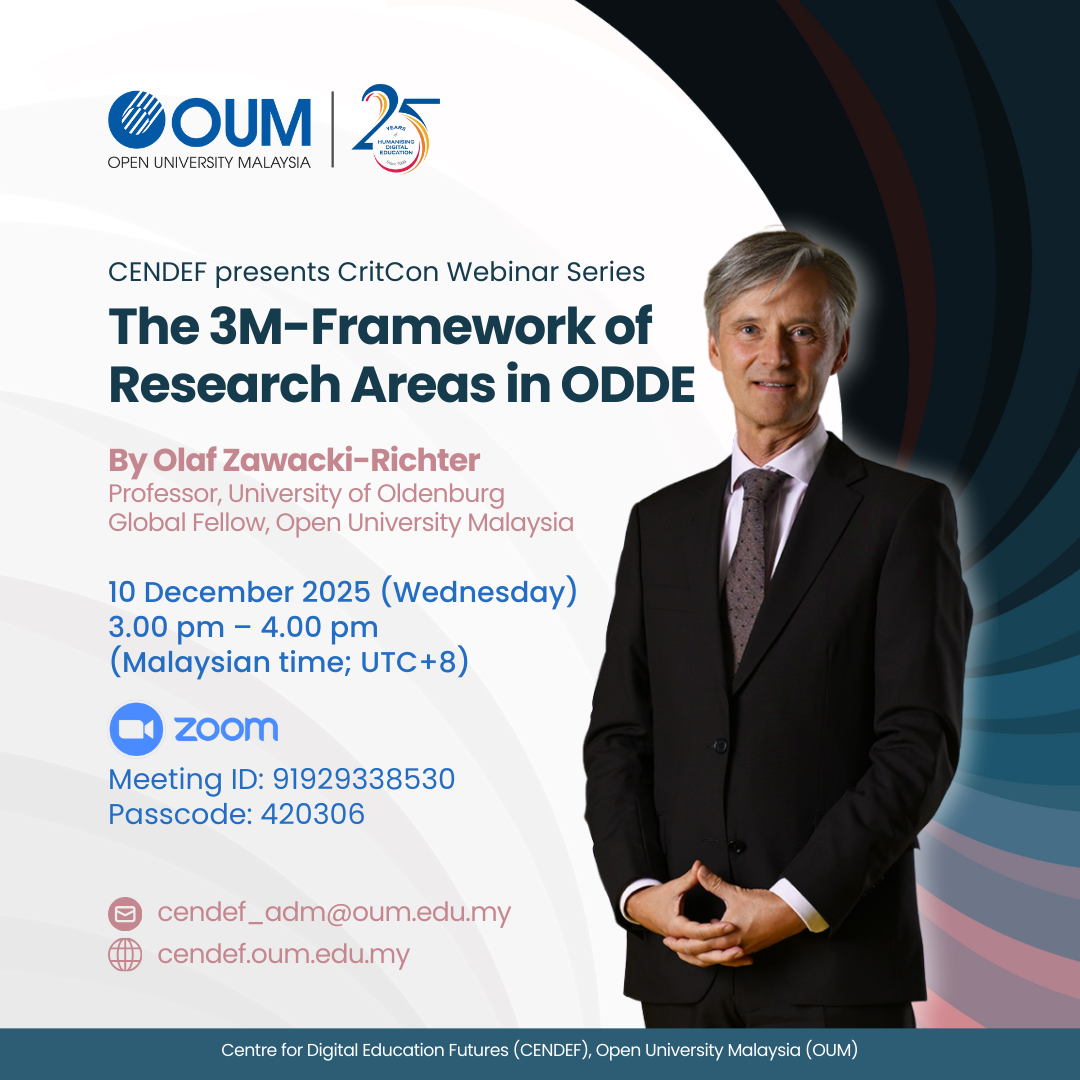
Centre for Digital Education Futures (CENDEF),
Open University Malaysia (OUM), proudly presents:
“Critical Conversations in Open, Distance, and Digital Education (ODDE)” (CritCon) Webinar Series
Webinar 5
The 3M-Framework of Research Areas in ODDE
By Olaf Zawacki-Richter
Professor, University of Oldenburg
Global Fellow, Open University Malaysia
Abstract
The dynamic field of Open, Distance, and Digital Education (ODDE) is shaped by rapid technological innovation, shifting learner expectations, and evolving educational policies. As research in this domain expands, educators, scholars, and practitioners need structured approaches to understand emerging trends and identify meaningful research opportunities.
This one-hour webinar introduces participants to the 3M-Framework of Research Areas in ODDE, a comprehensive model that organizes the field into three interconnected levels (macro, meso, and micro) and identifies fifteen core research areas. Developed through systematic analysis and expert consensus, the 3M-Framework provides a powerful lens for navigating the complexity of ODDE research.
Drawing on the chapter “Research Trends in Open, Distance, and Digital Education” by Zawacki-Richter and Bozkurt, the webinar explores the historical development of the field through four “research waves,” highlighting how ODDE scholarship has shifted from early concerns with access and design toward questions of quality assurance, interaction, emerging technologies, and data-driven education.
Participants will gain insights into which areas of ODDE research are well-established, which remain underexplored, and where new opportunities for inquiry are emerging, such as equity, learner support, artificial intelligence, and ethics.
The session combines concise input with interactive elements. Participants will connect the 3M-Framework to their own professional or research contexts. By the end of the webinar, attendees will have a clear understanding of the framework, current trends, and existing research gaps, enabling them to situate their work within the broader ODDE landscape and identify promising directions for future study.
Reference
Zawacki-Richter, O., & Bozkurt, A. (2023). Research Trends in Open, Distance, and Digital Education. In O. Zawacki-Richter & I. Jung (Eds), Handbook of Open, Distance and Digital Education (pp. 199–220). Springer Nature Singapore. https://doi.org/10.1007/978-981-19-2080-6_12
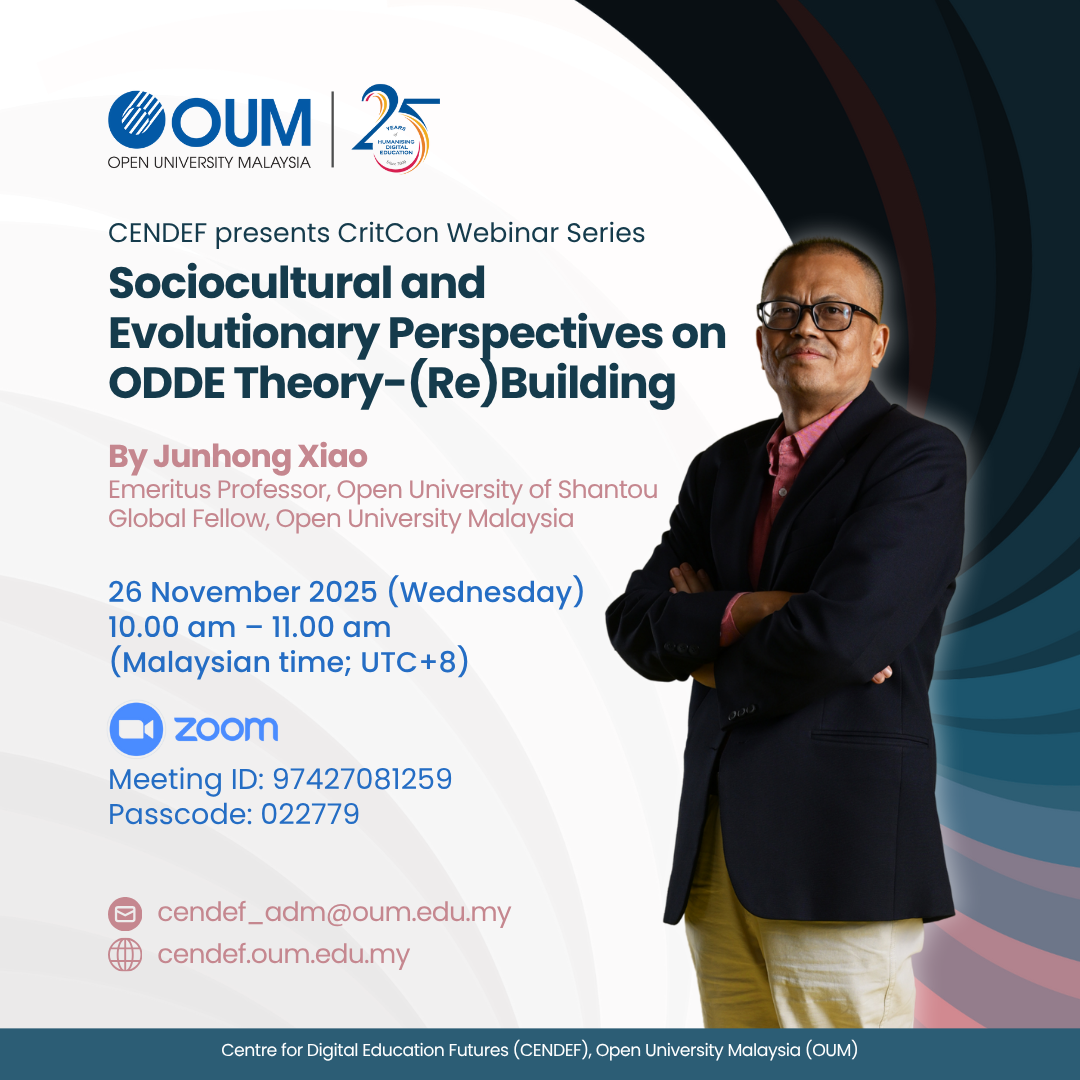
Centre for Digital Education Futures (CENDEF),
Open University Malaysia (OUM), proudly presents:
“Critical Conversations in Open, Distance, and Digital Education (ODDE)” (CritCon) Webinar Series
Webinar 4
Sociocultural and Evolutionary Perspectives on ODDE Theory-(Re)Building
By Junhong Xiao
Emeritus Professor, Open University of Shantou
Global Fellow, Open University Malaysia
Abstract
This webinar starts with a brief analysis of the sociocultural nature of education and educational technology. Given the predominant Western sociocultural background of both dedicated open, distance, and digital education (ODDE) theories, as well as theories borrowed from other disciplines to inform ODDE research and practice, a case is made for the need for (re)building ODDE theories from a sociocultural perspective.
It then briefly looks at the evolving landscape of ODDE, arguing that ODDE theories need to be evolving too to cater for emerging educational practices. Finally, the famous Transactional Distance Theory developed by Michael Grahame Moore is used to illustrate how we can rebuild classic ODDE theories from sociocultural and evolutionary perspectives, with a call for ODDE researchers and practitioners from non-Western backgrounds to develop new ODDE theories rooted in their specific sociocultural contexts.
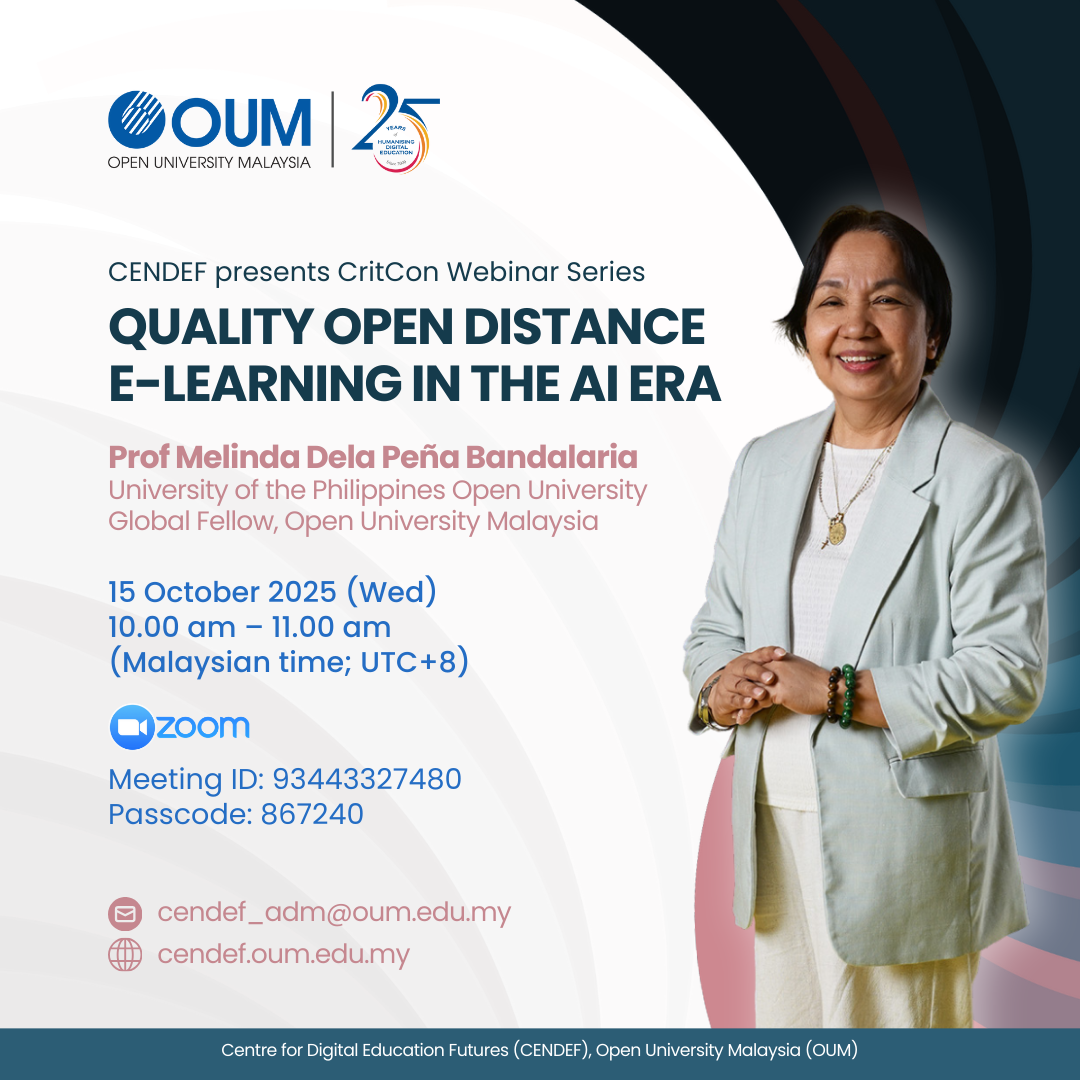
Centre for Digital Education Futures (CENDEF),
Open University Malaysia (OUM), proudly presents:
“Critical Conversations in Open, Distance, and Digital Education (ODDE)” (CritCon) Webinar Series
Webinar 3
QUALITY OPEN DISTANCE E-LEARNING (ODeL) IN THE AI ERA
Melinda dela Peña Bandalaria
Professor, University of the Philippines Open University
Global Fellow, Open University Malaysia
Abstract
Many higher education institutions are moving towards offering programs and courses through Open Distance eLearning (ODeL), prompted by the experience during the COVID-19 pandemic, which forced them to embrace this teaching and learning modality.
ODeL is being considered as another revenue stream, a sustainability model, and a mechanism by which the university can promote access and inclusion to education, and in the process contribute to the achievement of Sustainable Development Goals (SDGs).
While various Quality Assurance (QA) Frameworks, which basically share the same pillars, have been developed and practised through the years, mainly by open universities, the public introduction of GenAI now poses another challenge and raises the question: “How can we ensure quality education in the ODeL mode of instruction in the AI era?”
While there are tools that promise to detect GenAI use, many academics maintain that GenAI use should now be one of the associated skills we teach our students.
This webinar will take a cursory look at the existing QA Frameworks in ODeL to determine how the pillars of quality can be adjusted to accommodate AI use for both teachers and students.
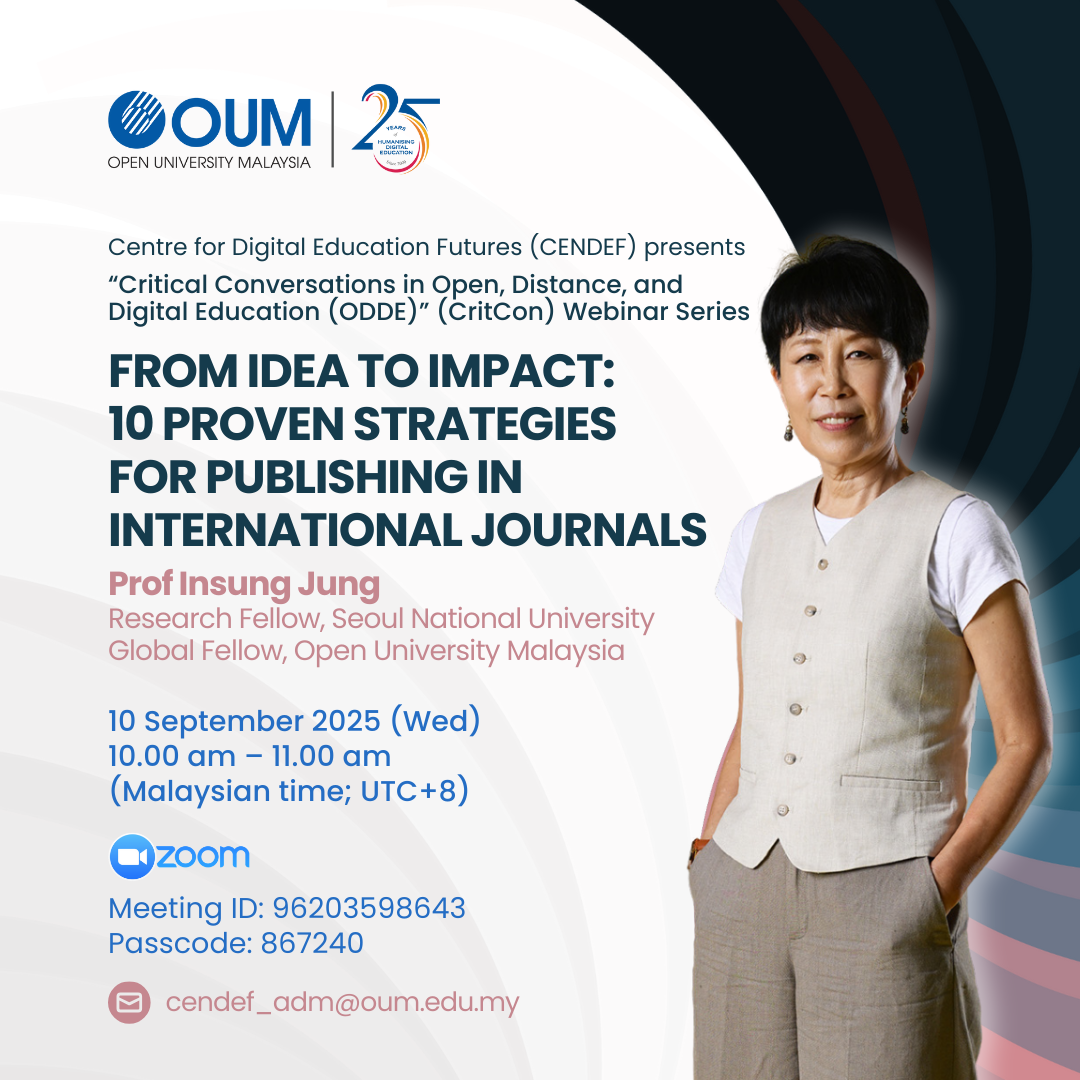
Centre for Digital Education Futures (CENDEF),
Open University Malaysia (OUM), proudly presents:
“Critical Conversations in Open, Distance, and Digital Education (ODDE)” (CritCon) Webinar Series
Webinar 2
FROM IDEA TO IMPACT: 10 PROVEN STRATEGIES FOR PUBLISHING IN INTERNATIONAL JOURNALS
By Prof Insung Jung
Research Fellow, Education Research Institute, Seoul National University
Global Fellow, Open University Malaysia
Abstract
This webinar is intended for academics seeking to publish internationally, with a particular focus on those at an early stage of their careers. Moving from idea to impact, it introduces the global publishing landscape, journal indexing, impact metrics, and ethical standards, including the responsible use of AI. Participants will be guided through ten proven strategies that address attitudes, habits, research quality, journal selection, networking, digital tools, and effective approaches to writing, reading, and editing. Special emphasis is placed on building a sustainable time-management system, cultivating productive habits, maintaining consistent writing and editing practices, and responding strategically to reviewer feedback. Drawing on real examples and practical tips, the session aims to strengthen both competence and confidence, equipping participants to begin their journey toward publishing in reputable international journals and contributing to meaningful scholarly impact worldwide.
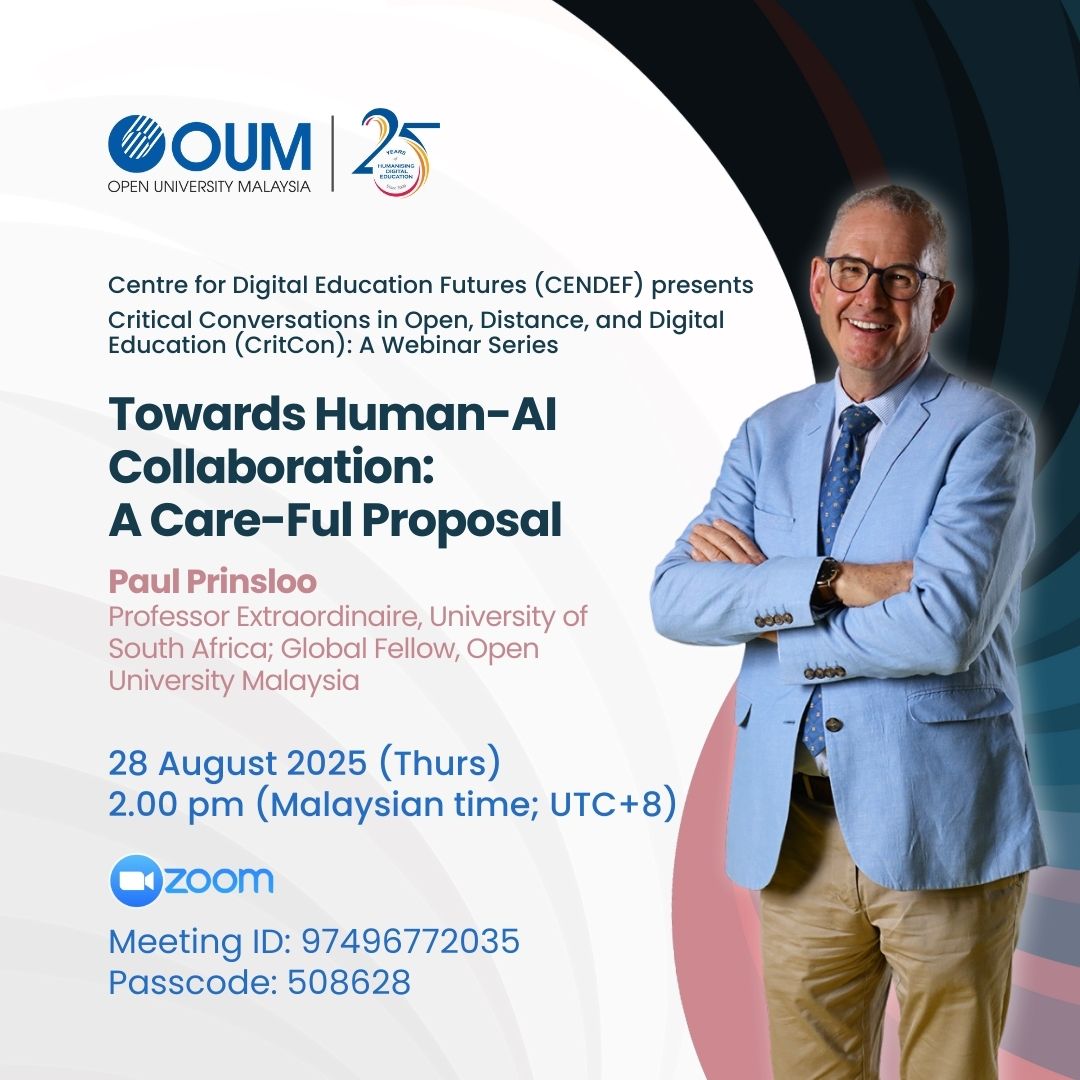
Webinar 1
Towards Human-AI collaboration: A Care-Ful Proposal
By Paul Prinsloo
Professor Extraordinaire, University of South Africa (Unisa)
Global Fellow, Open University Malaysia
Abstract
Throughout the evolution of humankind, technology and technological advances have always shaped not only how we relate to one another, but also how we engaged with and understood the world around us, and how we used technology to advance knowledge and coming-to-know (learning). Recent advances in Artificial Intelligence (AI) and specifically Generative AI (GenAI) open up possibilities and opportunities for deepening our understanding of the world around us and advancing scientific research. There are, however, also a range of concerns, challenges and perils in embracing AI as a partner in knowledge creation and learning. As such, embracing the potential of AI in teaching and learning needs care-ful consideration, critical engagement, and openness to think differently about, inter alia, the function and processes of assessment.