
About the Series
What kinds of futures are taking shape as digital technologies become part of everyday life in Southeast Asia? This question is at the heart of the OUM-CENDEF Southeast Asian Fellowship webinar series. The series looks at how people across the region make technologies their own, drawing on local histories and practices, and how those choices change the way they live and work. It also asks who gets a say in how these technologies are used and what possibilities might open up if more people had a hand in shaping them.
The webinar series offers a foretaste of the SEAF Anthology, a curated collection of immersive works that will premiere on 27 January 2027 at REXPERIENCE in downtown Kuala Lumpur. The webinars introduce some of the ideas and questions that audiences will encounter in a different form at the premiere.
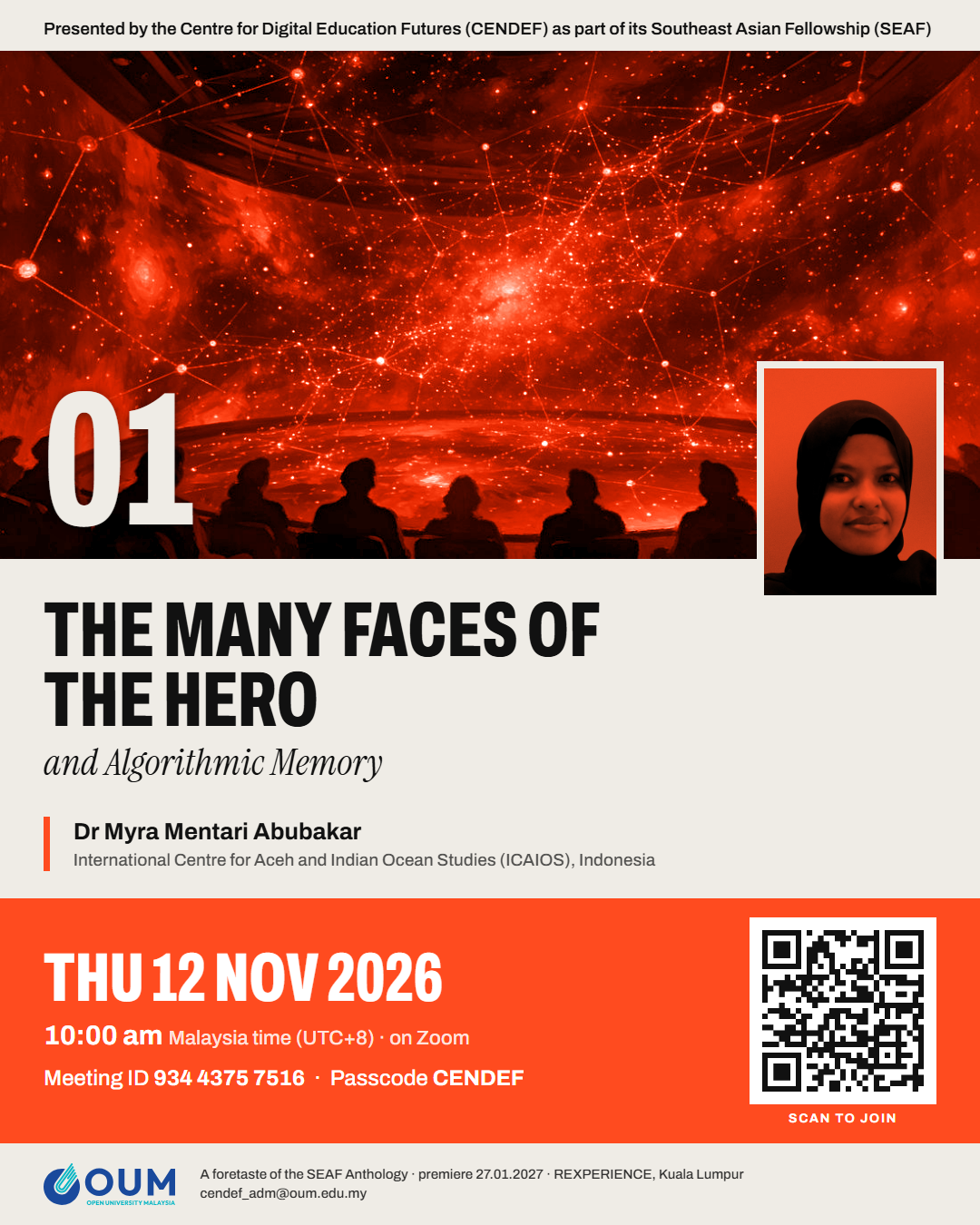
Webinar 1: The Many Faces of the Hero and Algorithmic Memory
Dr Myra Mentari Abubakar, International Centre for Aceh and Indian Ocean Studies (ICAIOS), Indonesia
Thursday, 12 November 2026, 10:00 am Malaysia time (UTC+8)
Abstract
This talk follows Acehnese commander Cut Nyak Din (1848–1908) across three archives: a 1905 Dutch capture photograph (KITLV 4356), a 1964 state portrait, and modern AI image generators. It centres on “fluent substitution”: when asked for an under-represented historical figure, AI tools do not return a blank but a confident picture of someone else. The presentation introduces an audit testing whether this substitution is gendered and previews the upcoming REXPERIENCE installation.
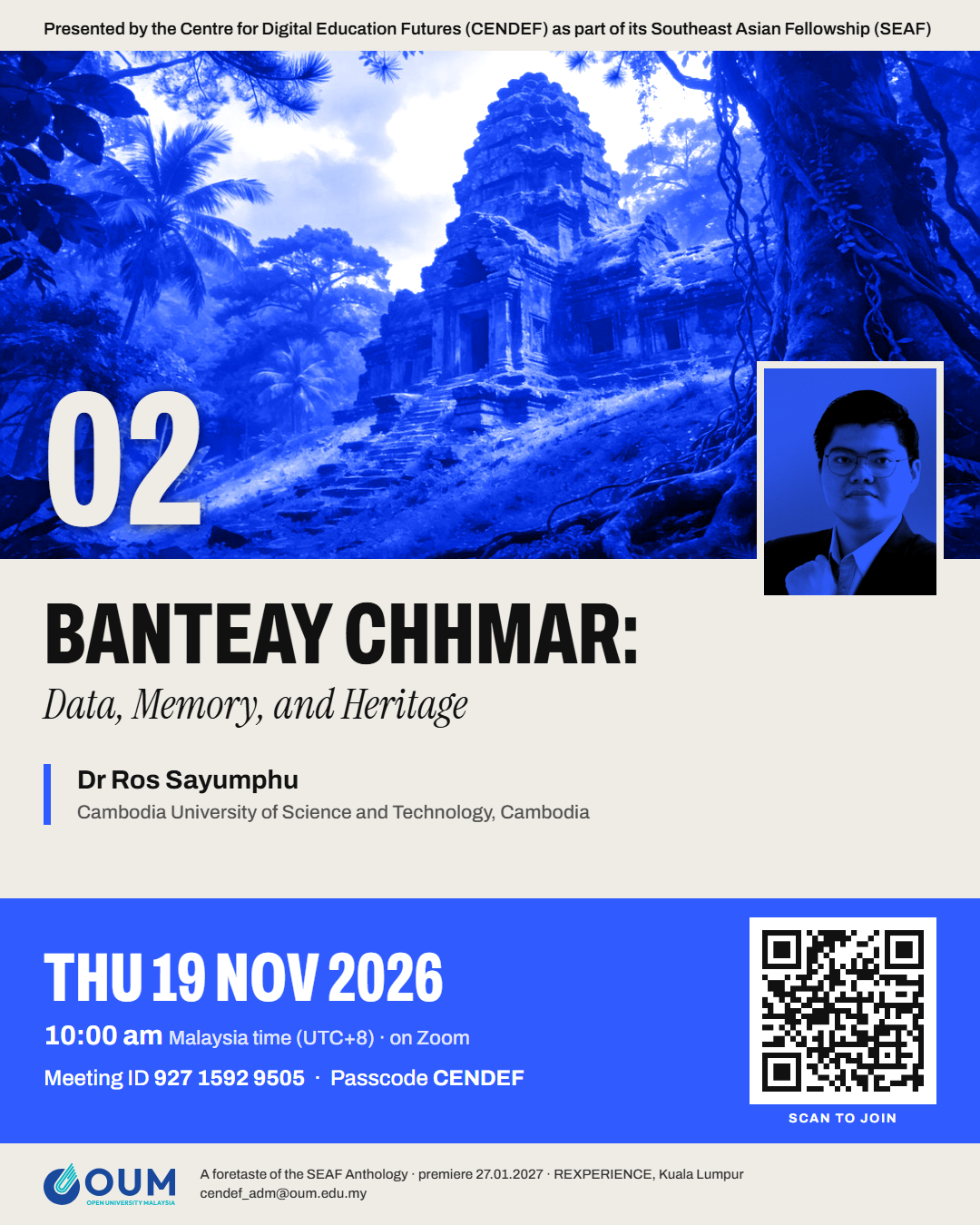
Webinar 2: Banteay Chhmar: Data, Memory, and Heritage
Dr Ros Sayumphu, Cambodia University of Science and Technology, Cambodia
Thursday, 19 November 2026, 10:00 am Malaysia time (UTC+8)
Abstract
Digital technologies are increasingly shaping how societies produce, access, and interpret knowledge. As information moves across digital platforms, the relationships between people, places, identities, and cultural practices are continuously transformed. While technological advancements create new opportunities for communication, participation, and knowledge sharing, they also raise critical questions about representation, accessibility, and power. Digital systems are not neutral; they influence which perspectives become visible, whose voices are amplified, and which forms of knowledge remain overlooked. Understanding these processes is essential for examining how digital transformation reshapes social relationships, cultural identities, and everyday experiences in contemporary Southeast Asian societies.
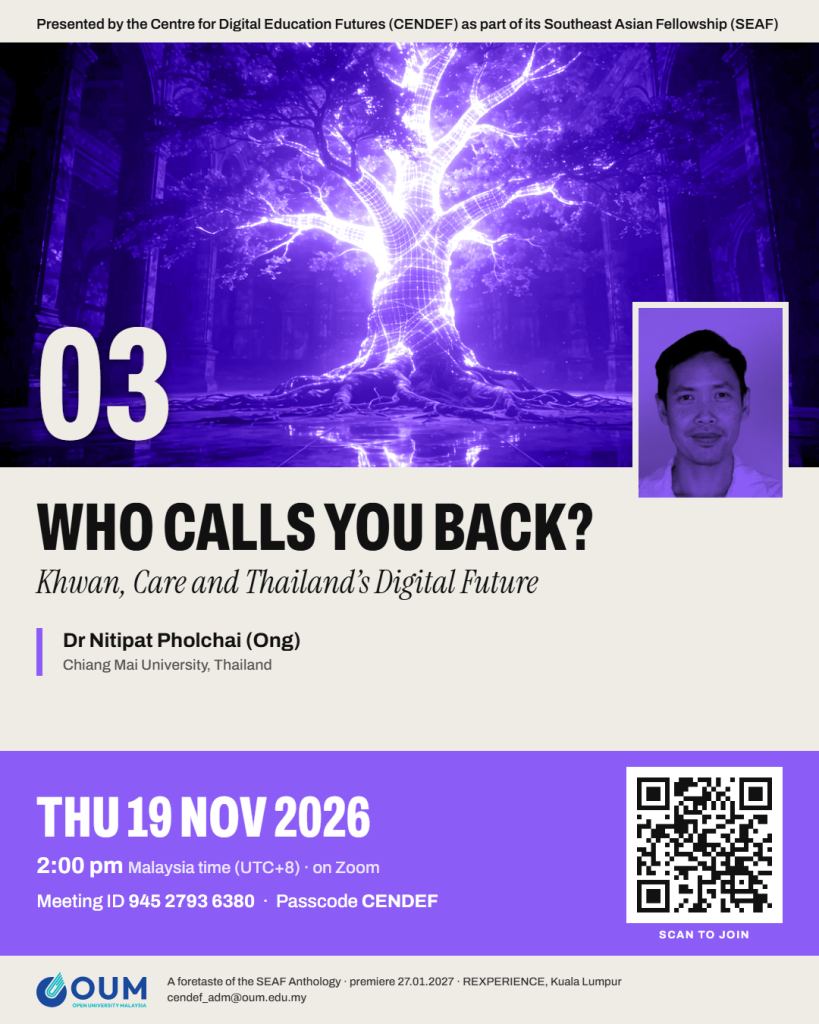
Webinar 3: Who Calls You Back? Khwan, Care and Thailand’s Digital Future
Dr Nitipat Pholchai (Ong), Chiang Mai University, Thailand
Thursday, 19 November 2026, 2:00 pm Malaysia time (UTC+8)
Abstract
Thailand is moving schooling, banking, health and government services onto digital platforms. These systems can notice users and act on them, but accountability within them is often unclear. This session examines what is lost in that shift. It focuses on khwan, the life essence that, in Thai and Lao belief, leaves a person after shock or loss and must be called back by others. Khwan rituals have served both institutional hierarchy and protest. Drawing on a 2026 practice-based project, it asks: can these rites be reworked into reciprocal care, and what would that reveal about digital systems?
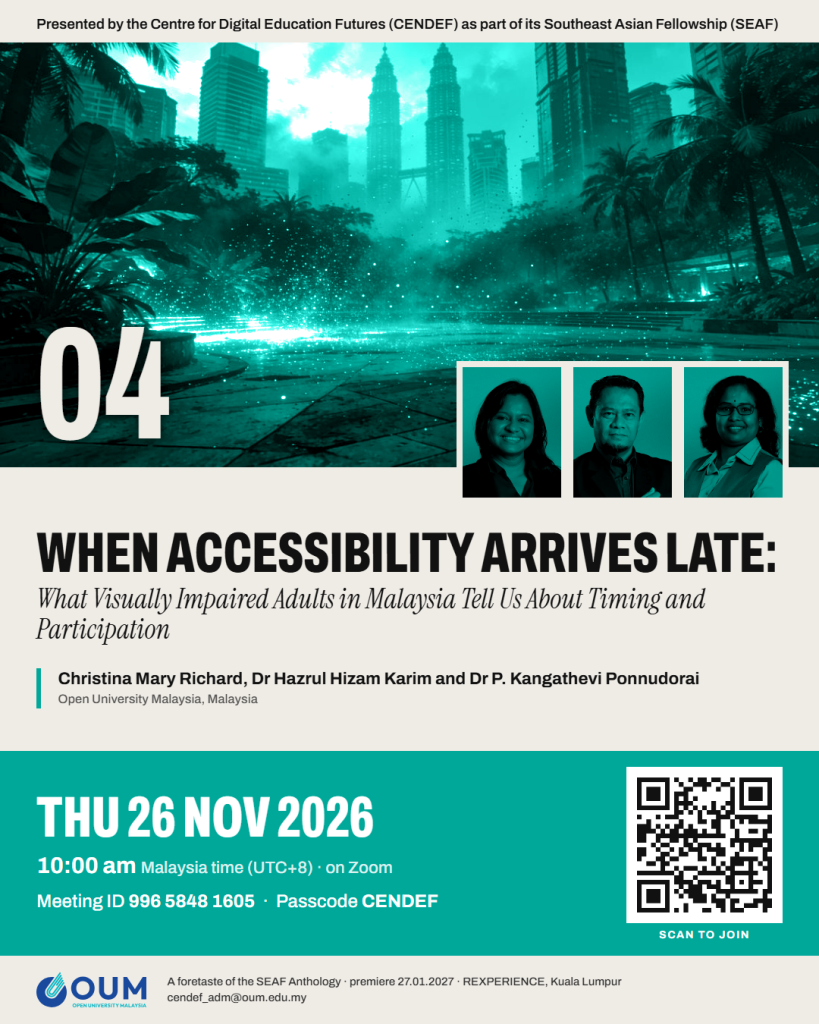
Webinar 4: When Accessibility Arrives Late: What Visually Impaired Adults in Malaysia Tell Us About Timing and Participation
Christina Mary Richard, Dr Hazrul Hizam Karim, and Dr P. Kangathevi Ponnudorai, Open University Malaysia, Malaysia
Thursday, 26 November 2026, 10:00 am Malaysia time (UTC+8)
Join on Zoom
https://zoom.us/j/99658481605
Meeting ID: 996 5848 1605
Passcode: CENDEF
Abstract
Accessibility can be available, but still arrive too late for visually impaired adults to take part in the learning moment that matters. Drawing on conversations with 17 visually impaired adults in Malaysia, this webinar examines how delayed access shapes participation in everyday learning. Participants described joining activities after others had moved on, needing extra time before they could begin, and working around systems that were not ready for them. These experiences raise a simple but important question at the heart of the study: how do visually impaired adults describe the effects of delayed digital access on their participation in learning?
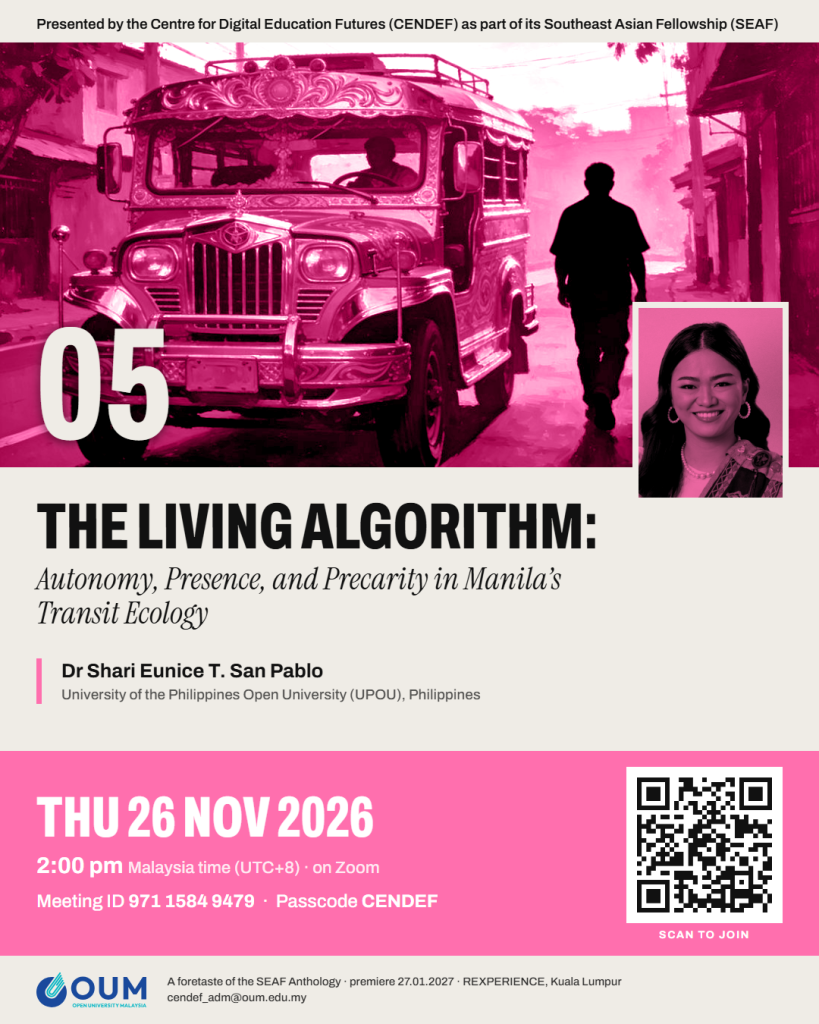
Webinar 5: The Living Algorithm: Autonomy, Presence, and Precarity in Manila’s Transit Ecology
Dr Shari Eunice T. San Pablo, University of the Philippines Open University (UPOU), Philippines
Thursday, 26 November 2026, 2:00 pm Malaysia time (UTC+8)
Join on Zoom
https://zoom.us/j/97115849479
Meeting ID: 971 1584 9479
Passcode: CENDEF
Abstract
Modern cities often assume technology can fix public transport, but traditional jeepney drivers in Metro Manila tell a different story. Drawing on field conversations, this talk explores why drivers avoid smartphone apps and digital maps, relying instead on street memory, verbal agreements, and fair terminal lines. However, while jeepney drivers keep control of their working hours, passenger loads are dropping as commuters shift to ride-hail apps. Connecting these field realities, this session shows how drivers keep moving through human skill and community trust without touching a screen.
WEBINAR V
The Living Algorithm: Autonomy, Presence, and Precarity in Manila’s Transit Ecology
Dr Shari Eunice T. San Pablo
University of the Philippines Open University (UPOU), Philippines
Abstract
Modern cities often assume technology can fix public transport, but traditional jeepney drivers in Metro Manila tell a different story. Drawing on field conversations, this talk explores why drivers avoid smartphone apps and digital maps, relying instead on street memory, verbal agreements, and fair terminal lines. However, while jeepney drivers keep control of their working hours, passenger loads are dropping as commuters shift to ride-hail apps. Connecting these field realities, this session shows how drivers keep moving through human skill and community trust without touching a screen.