
About the CritCon Webinar Series 2
CritCon is a platform for critical conversations on the evolving landscape of open, distance and digital education. The series brings together scholars and educators to question, reflect and exchange ideas on emerging issues, research and practices shaping the future of education.
In 2026, CritCon turns its critical lens to AI and digital transformation in education, exploring how emerging technologies are reshaping professional learning, teaching, research, educational futures and institutional practice.
S E R I E S A T A G L A N C E
I Beyond the Script: AI Use and Non-Use in Higher Education Teaching
15 October 2026 | 9:00 am (Malaysia time; UTC+8)
II Beyond the Script: How AI Is Reshaping the Research Landscape
27 October 2026 | 3:00 pm (Malaysia time; UTC+8)
III Speculative Approaches to a Digital Education Otherwise
28 October 2026 | 3:00 pm (Malaysia time; UTC+8)
IV Data Tells: Gaps in AI Adoption and Governance in Higher Education,
10 November 2026 | 3:00 pm (Malaysia time; UTC+8)
V Rethinking the Personalisation of Professional Learning Enabled by AI:
Empowerment and Agency
25 November 2026 | 10:30 am (Malaysia time; UTC+8)
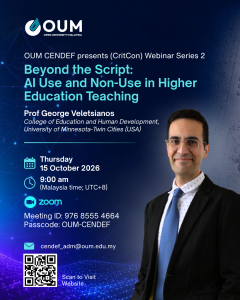
WEBINAR I
Beyond the Script: AI Use and Non-Use in Higher Education Teaching
Prof George Veletsianos
College of Education and Human Development, University of Minnesota-Twin Cities (USA)
Abstract
Faculty members’ use of Generative AI (GenAI) is complicated by a variety of factors ranging from their pedagogical intent, their beliefs about teaching and learning, and the technology’s varied impacts and harms. In this talk, I am going to share preliminary findings from a study examining how and why US faculty members use, or choose not to use, GenAI in their teaching. By examining both use and non-use, I highlight the nuanced ways in which instructors negotiate these technologies.
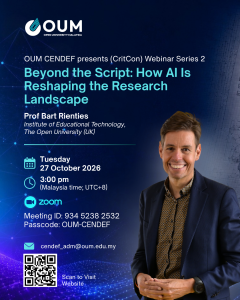
WEBINAR II
Beyond the Script: How AI Is Reshaping the Research Landscape
Prof Bart Rienties
Institute of Educational Technology, The Open University (UK)
Abstract
How can researchers move beyond established scripts to make meaningful use of artificial intelligence? Drawing on research in learning analytics, AI digital assistants and the UK Research Capability Hub (rch.ac.uk), this webinar explores how generative AI can support research design, evidence synthesis, analysis and collaboration. It examines the tensions between innovation and rigour, efficiency and critical thinking, and personalised support and unequal access. Through practical examples and emerging evidence, Professor Bart Rienties considers the capabilities researchers need to evaluate and use AI responsibly, while retaining human judgement, methodological diversity and scholarly independence.
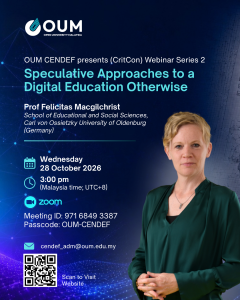
WEBINAR III
Speculative Approaches to a Digital Education Otherwise
Prof Felicitas Macgilchrist
School of Educational and Social Sciences, Carl von Ossietzky University of Oldenburg (Germany)
Abstract
How do we actually do the work of moving beyond standard scripts, to imagine a “digital education otherwise”? How do we set this imagining in motion, to make the transformations necessary for more just and equitable educational futures? In this webinar, Felicitas Macgilchrist will give a short introduction to speculative methods for creating im/possible futures. Participants will then engage in selected methods from speculative inquiry. They will co-create futures otherwise for digital education. The webinar will end with a shared discussion of these futures, reflection on the methods, and steps forward in teaching and scholarship.
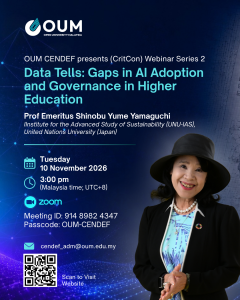
WEBINAR IV
Data Tells: Gaps in AI Adoption and Governance in Higher Education
Prof Emeritus Shinobu Yume Yamaguchi
Institute for the Advanced Study of Sustainability (UNU-IAS), United Nations University (Japan)
Abstract
This webinar will share key findings from a recent study “AI implementation in higher
education in Latin America and the Caribbean”, jointly conducted and published by UNU
IAS and UNESCO International Institute for Higher Education in Latin America and the
Caribbean.
The survey of 200 institutions across 19 countries in the region reveals notable gaps between rapid adoption of AI by faculty members and institutional and governance readiness at the leadership level. The findings are structured around three pillars; 1) Patterns of AI adoption across three core missions of universities (i.e. teaching and learning, research, and community engagement), 2) Gaps in governance and institutional readiness; and 3) Key enablers and challenges. The presentation concludes with a set of actionable and evidence-based policy recommendations for higher education institutions, national policy makers, and regional/international organizations.
The webinar will invite participants to reflect on their own institutional contexts and exchange.
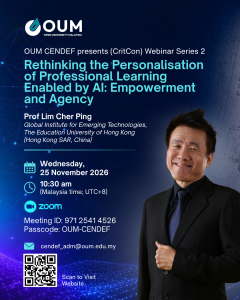
WEBINAR V
Rethinking the Personalisation of Professional Learning Enabled by AI: Empowerment and Agency
Prof Lim Cher Ping
Global Institute for Emerging Technologies, The Education University of Hong Kong (Hong Kong SAR, China)
Abstract
Teacher professional development (TPD) activities have often been initiated and coordinated at the system level of the country, city or/and school. For these activities to be inclusive and of equitable quality, localisation and personalisation are necessary. However, this approach still assumes that TPD is planned and coordinated at the system level where teachers are expected and empowered to engage in these activities. This presentation discusses how TPD@Scale has to be reimagined in the AI era, with teachers taking up the opportunities of AI to monitor and manage their own professional learning, thereby moving beyond teacher empowerment towards teacher agency.